World's biggest solar telescope being built with NI expertise 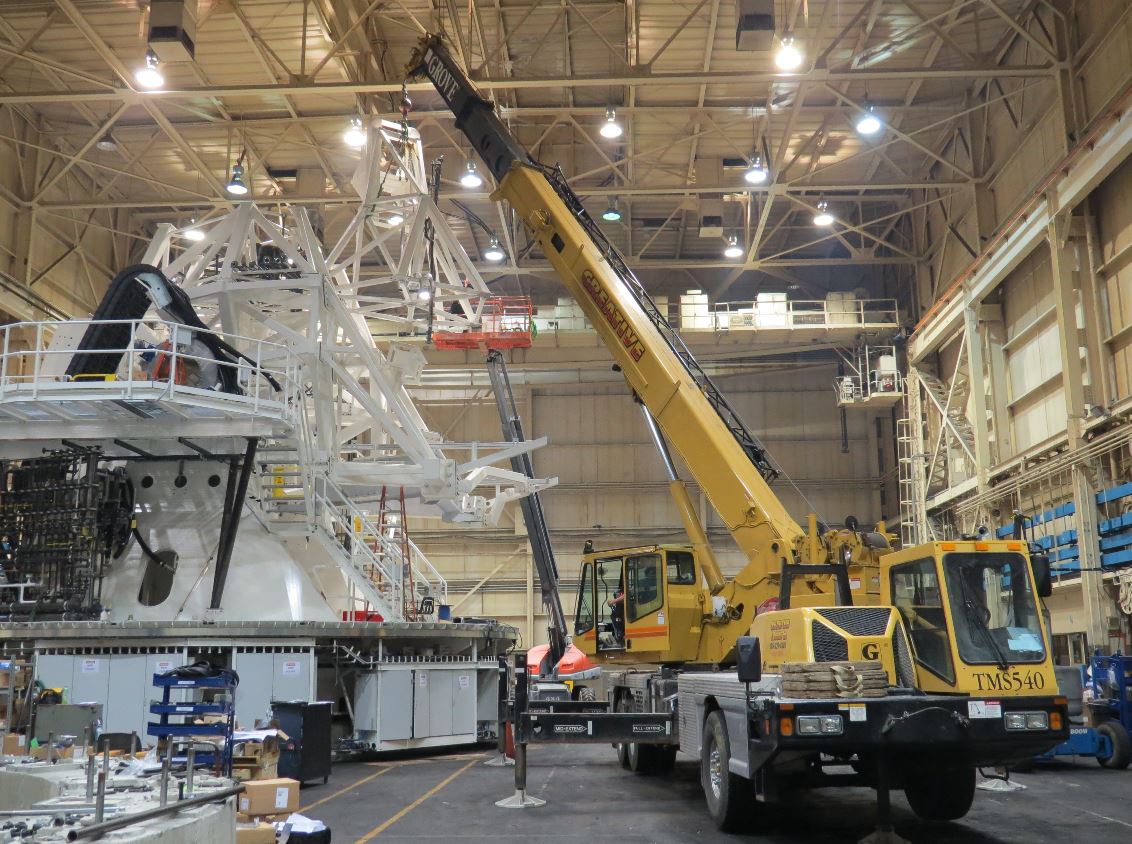
11 February 2015
A consortium of eight UK universities and associated businesses – lead by Queen’s – is to build the cameras for the $344m super-telescope, which will be located in Hawaii.
The Daniel K Inouye Solar Telescope (DKIST), which will be launched in 2019, is being constructed by the US National Solar Observatory on Haleakala Mountain in Maui, Hawaii.
With a four-metre diameter primary mirror, the telescope will be able to pick up unprecedented detail on the surface of the Sun – the equivalent of being able to examine a £1 coin from 100kms away.
It is hoped that DKIST will address fundamental questions at the core of contemporary solar physics. It will do this via high-speed (sub-second timescales) spectroscopic and magnetic measurements of the solar photosphere, chromosphere and corona.
DKIST is funded by the US National Science Foundation with £2.5m of support provided by the Science and Technology Facilities Council, one of Europe’s largest multi-disciplinary research organisations.
 Professor Mihalis Mathioudakis of the Astrophysics Research Centre at Queen’s, Principal Investigator of the UK consortium, said: “The Sun is the most important astronomical object for humankind with solar activity driving space weather and having profound effects on global climate and technology-based communications. To understand solar activity we need to observe and model the physical processes in the solar atmosphere on their intrinsic spatial and temporal scales so that, among other questions, we can reliably forecast this activity in space.
“Scientific discoveries demand technological innovation and play a major role in economic growth. DKIST will be a revolutionary instrument for ground-based solar physics, which is a growth area in the UK. It will be in a position to explore key questions regarding solar magnetic field generation and dissipation, solar variability, atmospheric structure and dynamics.
“Our consortium will deliver key equipment that will allow DKIST to achieve these scientific goals and it’s another example of how Queen’s research impacts on society, both locally and internationally.”
The consortium will oversee the development and delivery of the cameras, and take the lead in supporting the UK solar physics community in their use of DKIST by providing a set of processing tools for DKIST data, synthetic observations to validate diagnostic approaches, and support for developing observing proposals.
DKIST Director, Dr Thomas Rimmele said: “We are excited to have the UK consortium on board as partners. DKIST will be the world's most powerful solar telescope. The scientific and technological expertise represented by the Queen's-led consortium is a great asset to the project.”
Dr Donal Denvir, Technical Director at Andor Technology, said: “Andor will play a central role in the design and manufacture of state-of-the-art detectors for this high-profile, solar-physics initiative. The technology will provide an innovative combination of high-performance specifications that simply do not exist today, a solution that will prove enabling not only for next-generation solar studies, but for the wider professional astronomy community and beyond.”
Professor Gerry Doyle, Head of Solar Physics research at Armagh Observatory, said: “This is the only game-in-town as regards ground-based solar physics for the next decade and we are delighted to be involved with this project at such an early stage. Construction of the telescope has already begun. Astronomical research at Armagh Observatory is supported by the Northern Ireland Department of Culture Arts and Leisure.”
Other UK institutes involved in DKIST include University College London, and the Universities of Glasgow, St. Andrews and Warwick.
For more information contact the Queen’s Communications Office on +44 (0)28 9097 5320 (Mon-Wed) or +44 (0)28 9097 5310 (Thurs-Fri) or email comms.officer@qub.ac.uk
Photographs: Courtesy of National Solar Observatory/AURA/NSF
Back to Main News
Top of Page